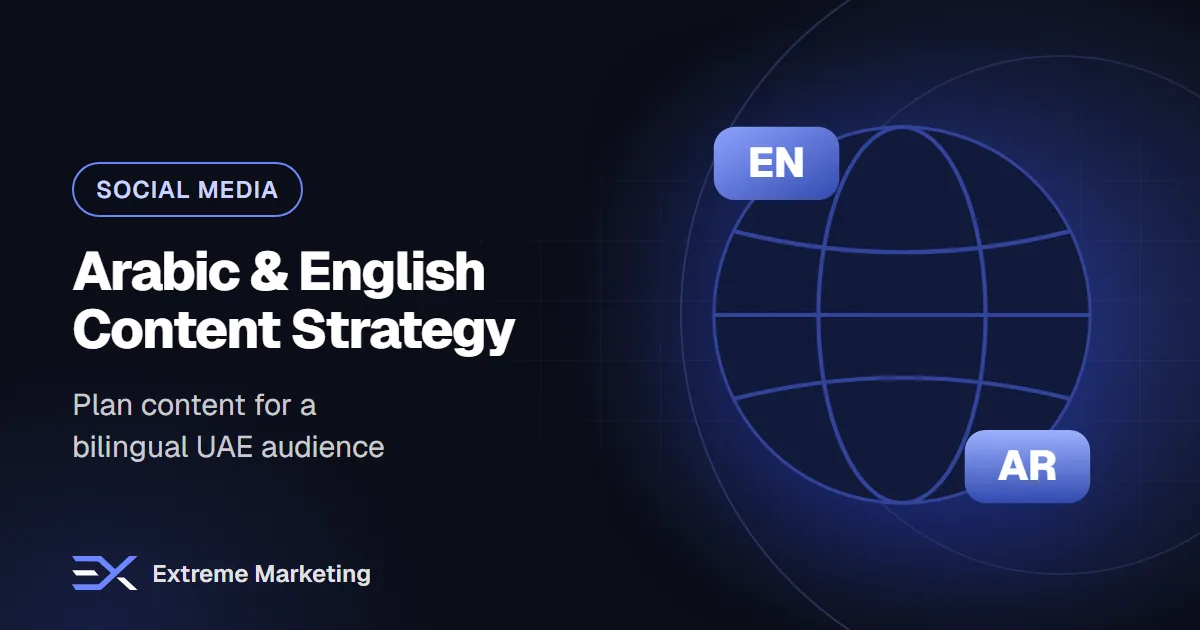
The UAE is one of the most multilingual markets in the world. Your customers may include Emiratis, Arab residents and people from many other countries. Some prefer Arabic, some prefer English and many switch depending on the topic or platform. A bilingual content strategy is not just translation; it is a set of decisions about who you are talking to, in which language and with what tone.
This guide helps you plan content for both languages in a way that fits your audience and your team's capacity.
Step 1: Learn your audience's language habits
- Check platform insights for audience location and language, where available.
- Look at the language of comments, direct messages and WhatsApp enquiries.
- Ask new customers which language they prefer.
- Note which posts in each language get more saves, shares and replies.
- Remember that people may prefer Arabic for family and community content and English for technical or professional topics.
Step 2: Choose a language model
Model A: Separate accounts
One Arabic account and one English account. This gives each audience a clean experience but doubles the work of posting, replying and growing. It suits larger brands.
Model B: One account, separate posts
Some posts in Arabic and some in English on the same account, with each post in one language. Simple to manage but audiences may feel half the feed is not for them.
Model C: One account, bilingual posts
Each post includes both languages, for example Arabic text in the image and English in the caption, or both in the caption. This is common in the UAE, and works well when the design handles both scripts neatly.
Model D: Language by platform
For example, Arabic-first on Snapchat and Instagram, English-first on LinkedIn. This follows where each audience actually spends time.
Choose the model that matches your audience and your resources. You can change it as you learn.
Step 3: Write natively, not by translation
- Have a native speaker write or adapt the Arabic, so that it sounds natural, not literal.
- Adapt jokes, idioms and cultural references. What works in English may not translate.
- Choose the register: formal Arabic, a lighter modern tone or a Gulf-flavoured style, depending on your brand and audience.
- Keep brand names consistent, deciding whether to show them in Latin letters, Arabic letters or both.
- Check numbers, dates and currency formatting in each language.
Step 4: Design for both scripts
- Choose fonts that look good in Arabic and Latin and match each other in weight.
- Arabic is written right to left. Check text alignment and the order of elements in designs.
- Give Arabic text enough space and line height; Arabic often needs more vertical room.
- Avoid letter-spacing on Arabic text, which breaks the joining of letters.
- Make sure video captions are legible and correctly ordered in both languages.
Step 5: Plan content pillars that work in both languages
Keep the same core pillars, such as education, proof, behind the scenes and offers, and adapt the delivery.
- Some content can be shared across languages with only the text changed, such as product highlights.
- Some content should be created separately, such as culturally specific moments, local trends and humour.
- Some content is language-specific by nature, such as Arabic poetry, calligraphy or Ramadan greetings.
- Keep a shared calendar with columns for Arabic and English versions.
Step 6: Hashtags, captions and keywords
- Use Arabic hashtags and keywords in Arabic content and English ones in English content, based on what your audience actually searches.
- Do not stuff both languages into one huge block of hashtags.
- Put the most important information at the start of the caption in each language.
- In bilingual captions, separate the languages clearly, so that each reader finds their version quickly.
Step 7: Customer service in both languages
- Reply to each person in the language they used.
- Prepare saved replies in Arabic and English.
- Make sure your team includes people who can handle both languages confidently.
- For WhatsApp, set an automatic greeting that offers both language options.
Step 8: Cultural calendar
Plan around moments that matter to Arabic-speaking and international audiences: Ramadan and Eid, National Day, school holidays, major sales and local events. Check confirmed dates each year. Our seasonal planning guide gives a framework.
Step 9: Ads in both languages
- Create separate ad sets for Arabic and English audiences with matching creative.
- Use language targeting carefully and test.
- Review results by language to see where to invest more.
- Send each audience to a landing page in their language.
Step 10: Measure by language
- Compare reach, engagement and saves by language.
- Compare enquiries and sales from Arabic and English posts.
- Check follower growth in each language segment where data allows.
- Ask customers what they prefer.
- Adjust the balance every quarter.
Workflow tips for small teams
- Write the main idea once in the language you think in, then adapt, not translate.
- Use a checklist for both versions: facts, tone, links, hashtags and design.
- Have a native reviewer for each language.
- Batch production: record a video once, then add subtitles in both languages.
- Keep a glossary of key terms and how to write them in each language.
Common mistakes
- Machine-translating captions.
- Placing Arabic text in a design built only for Latin text.
- Mixing languages awkwardly in one sentence.
- Posting only in English by default.
- Treating Arabic as an afterthought with smaller budgets.
- Using inconsistent brand name spellings.
- Not replying in the customer's language.
Frequently asked questions
Should I post everything in both languages?
Not necessarily. Start with your most important content and expand as your team can handle.
Which language should come first in a bilingual caption?
Choose based on your main audience on that platform, and be consistent.
Do I need a native Arabic copywriter?
For public-facing content, yes. It protects your brand and tends to improve results.
Our social media team writes, designs and publishes bilingual content with native-quality Arabic. Message us on WhatsApp or book a free 30-minute call.
Want help putting this into practice?
Book a free audit and we will review your marketing and suggest the quickest wins.