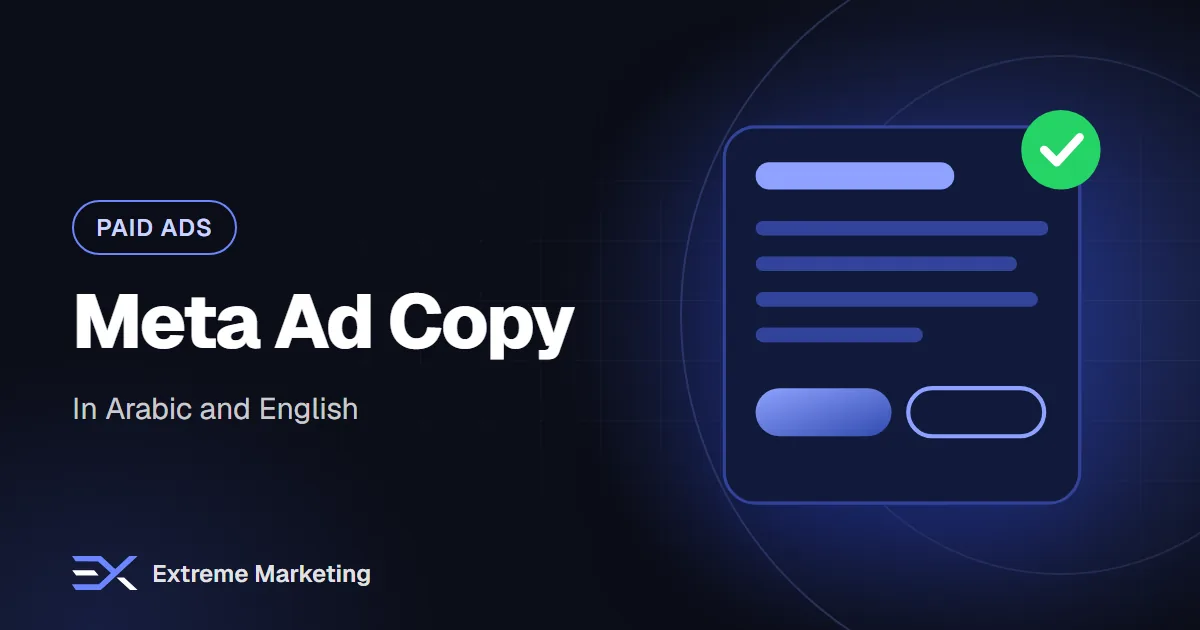
Ad copy is the words that sit with your image or video: the headline, the primary text and the button. Even strong creative can fail if the words are vague, stiff or off-target. In the UAE you also have two main languages to consider, and a literal translation rarely works.
This guide gives you a simple structure for writing Meta ad copy, along with specific advice for Arabic and English. Platform formats and policies change, so check the current ad specifications and rules in Ads Manager.
The parts of a Meta ad
- Primary text: the main message above the image or video. The first lines are most visible.
- Headline: a short line below the media, often near the button.
- Description: extra text that may or may not show, depending on placement.
- Call-to-action button: such as Book now, Send message or Learn more.
- Creative: the image or video, which does most of the attention-grabbing.
A simple copy structure
- Hook: speak to a specific person or problem in the first line.
- Benefit: say what they get, not just what you do.
- Proof: add a short credibility point that is true and supportable.
- Offer: state the offer and any conditions clearly.
- Call to action: tell them exactly what to do next.
Example: a family dental clinic (illustration)
Hook: Looking for a dentist your kids will not be afraid of? Benefit: Gentle family dentistry in JLT, with every step explained in Arabic or English. Proof: Evening appointments available. Offer: Book a free first consultation this month. Call to action: Tap Book now or message us on WhatsApp.
Write the hook
- Address a specific person: 'Dubai business owners', 'new mums in Abu Dhabi'.
- Name a problem: 'Tired of leads that never answer the phone?'
- Ask a relevant question.
- State a surprising fact only if you can support it.
- Show the result first: 'A clean, ready-to-rent flat in three days'.
- Keep the first line short, because many viewers see only a few words before 'See more'.
Benefits beat features
- Feature: 'We have 20 technicians.' Benefit: 'Same-day AC repair across Dubai.'
- Feature: 'Our cream contains vitamin C.' Benefit: 'Brighter-looking skin in your morning routine.' (Follow advertising rules on claims.)
- Feature: 'Free WhatsApp support.' Benefit: 'Get answers in minutes, without waiting on hold.'
Be specific and honest
- Use numbers, places and details that are true.
- State prices or starting prices when it helps, with conditions.
- Avoid exaggerated claims, guarantees you cannot back up or personal attributes targeting.
- Remember that Meta's policies restrict certain claims, especially in health, finance and before-and-after images. Check them before launch.
- Follow UAE advertising rules for your industry, including any required licence details.
The call to action
- One clear action per ad: book, message, call or buy.
- Match the button to the action: 'Send message' for WhatsApp ads, 'Book now' for appointments.
- Add urgency only when real, such as a genuine deadline.
- Tell people what happens next: 'We reply within the hour.' Only say it if you can deliver.
Writing Arabic ad copy
- Have a native writer create the copy from the brief, not translate the English line by line.
- Choose the register deliberately: modern standard Arabic for broad reach, or a lighter Gulf-flavoured tone for local, casual brands. Keep it respectful and easy to read.
- Keep sentences short. Arabic ads often read better with simple, direct phrasing.
- Check how the text displays in a right-to-left preview, including punctuation, numbers and mixed English words.
- Write numbers and prices consistently, and decide on Eastern or Western numerals for your brand.
- Do not use letter-spacing, and avoid text-in-image that is hard to read on phones.
- Use calls to action that sound natural: 'احجز الآن', 'تواصل معنا عبر واتساب', 'اطلب عرض سعر'.
Writing English ad copy for the UAE
- Use clear, plain English that international readers can understand quickly.
- Avoid idioms that confuse non-native readers.
- Mention local references, such as areas, landmarks and seasons, where relevant.
- Keep spelling consistent, such as British or American, across your brand.
Mixing the languages
- Create separate ads and ad sets for Arabic and English audiences with matching creative.
- If one ad must be bilingual, separate the languages clearly and keep each short.
- Send each audience to a landing page in the same language.
- Compare results by language to see where to invest.
Length and formatting
- Put the most important message in the first two lines.
- Use short paragraphs and line breaks.
- Use emojis sparingly and only if they fit your brand.
- Use bullet points to list benefits, where placements allow.
- Test short and long versions: some audiences prefer brief, others like detail.
Match copy to the funnel stage
- Cold audiences: lead with a relatable problem or an interesting idea, with a soft call to action.
- Warm audiences: add proof, specifics and a stronger offer.
- Retargeting: remove doubts, remind them of the offer and make the next step easy.
- Customers: invite reviews, reorders or referrals.
Test your copy
- Change one element at a time: the hook, the offer or the call to action.
- Run versions at the same time with the same audience and budget.
- Judge by cost per result and lead quality, not only click-through rate.
- Keep the winner and test a new challenger.
- Record what you learn in a simple log.
Our guide to creative testing explains how to structure tests so that results are meaningful.
A copy checklist
- Does the first line speak to the right person?
- Is there a clear benefit?
- Is every claim true and allowed?
- Is the offer and its condition clear?
- Is there one obvious next step?
- Does the Arabic read naturally to a native speaker?
- Does the landing page match the ad?
Common mistakes
- Talking about the company instead of the customer.
- Translating Arabic from English word for word.
- Too many messages in one ad.
- Vague calls to action such as 'Learn more' when you want a booking.
- Claims that break ad policies.
- Sending traffic to an unrelated page.
- Never testing alternatives.
Frequently asked questions
How long should ad copy be?
As long as it needs to be. Short copy suits simple offers; longer copy can work for considered purchases. Test both.
Should I use the same copy in both languages?
Use the same message, but write each version natively. Direct translation often sounds unnatural.
Do emojis help?
Sometimes. Use them to highlight, not to decorate, and check how they look in Arabic text.
Our team writes and tests ad copy in Arabic and English for Meta campaigns. Message us on WhatsApp or book a free 30-minute call.
Want help putting this into practice?
Book a free audit and we will review your marketing and suggest the quickest wins.